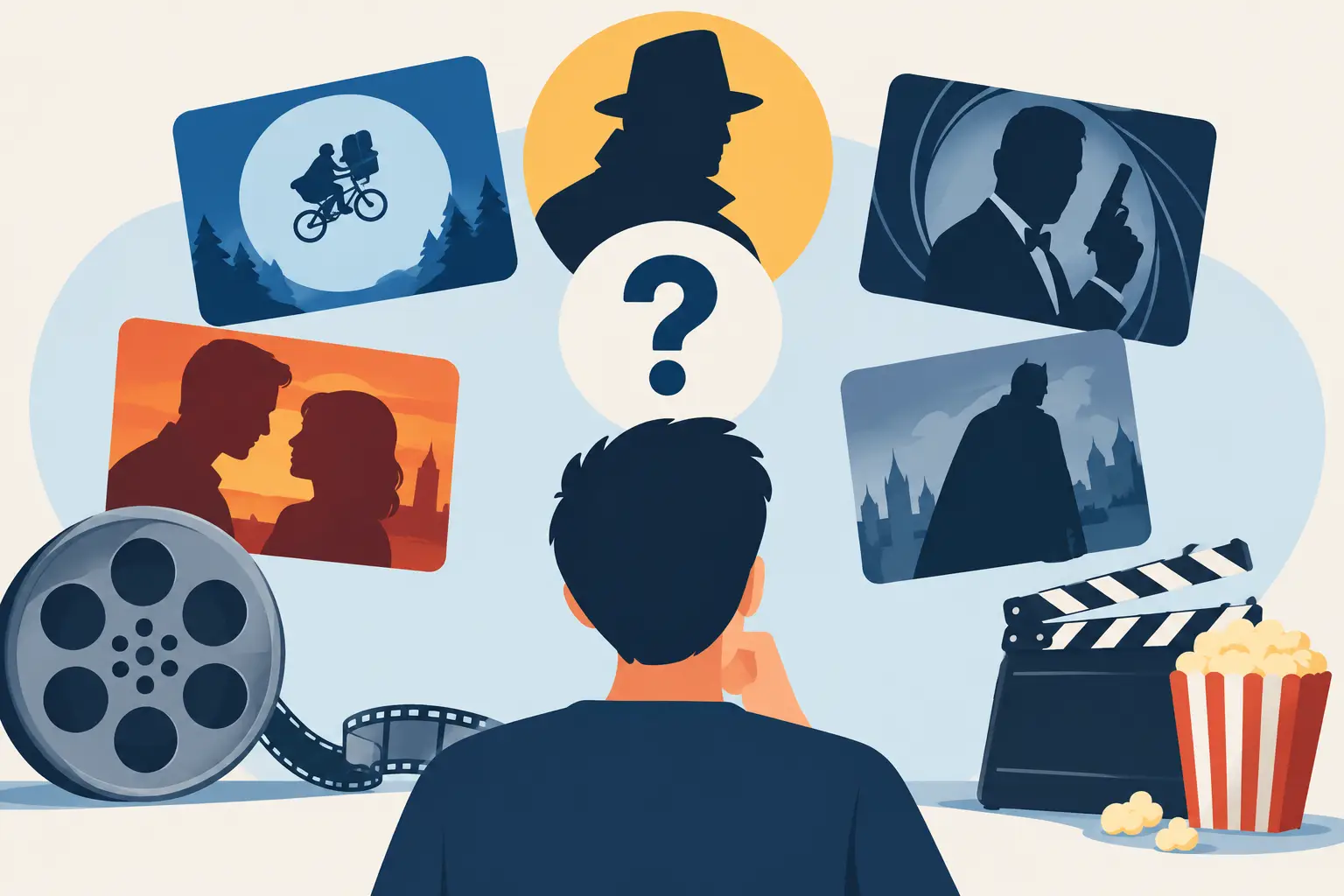
A great movie clue does not hand over the answer. It gives you that satisfying half-second of panic first: You know the detail, you know the film, but can you connect them before anyone else? These film clue examples show how a single object, line, location, or character detail can turn movie knowledge into a fast, fun puzzle.
The best clues feel obvious after the reveal. The trick is choosing details that are specific enough to point toward one answer, but not so specific that the puzzle is over before it begins.
What Makes a Film Clue Work?
A film clue needs a clear path from hint to title. That path might run through an iconic prop, a memorable setting, a strange job, a famous piece of dialogue, or a plot detail that only makes sense in one movie.
The strongest clues usually sit in the middle of the difficulty scale. “A shark attacks a beach town” gets Jaws instantly. “A troubled man faces danger” could describe hundreds of movies. But “A police chief, an oceanographer, and a shark hunter board a small boat” gives players enough to work with while still making them earn it.
Recognition also depends on the audience. A clue about a 1990s thriller may be easy for one group and impossible for another. That is not a flaw. Good movie puzzles mix eras, genres, and levels of difficulty so one player’s instant answer becomes another player’s new watchlist pick.
15 Film Clue Examples and Why They Click
Iconic objects
1. A spinning top that may never stop. The answer is Inception. The object is simple, visual, and tied directly to the movie’s central question. It is a strong clue because players do not need to recall every character or plot layer.
2. A pair of ruby slippers becomes the way home. The Wizard of Oz is the answer. This is an easy clue, but easy clues have a role: they create momentum, especially at the start of a daily puzzle.
3. A briefcase glows, but no one sees what is inside. That points to Pulp Fiction. The mystery is part of the clue’s appeal. You are identifying not just a prop, but a pop-culture moment.
4. A red balloon follows children through a small town. The answer is It. Color, object, and setting combine to keep the clue fair. “A creepy clown” alone would be much less distinctive.
Places that carry the whole movie
5. Guests check in to an isolated mountain hotel for the winter. This clue leads to The Shining. The Overlook Hotel is so central that its location acts like another character.
6. Dinosaurs escape at a theme park built on an island. The answer is Jurassic Park. It is broad enough for casual players but still unmistakable because the premise is so clean.
7. A luxury ocean liner heads toward disaster on its first voyage. Titanic is the answer. This is another accessible clue, though it works better in a mixed set than in a challenge aimed at serious film buffs.
8. A desert planet becomes the center of an intergalactic power struggle. That points to Dune. The clue gives genre and setting without naming a character, which makes it useful when a puzzle wants to avoid obvious proper nouns.
Jobs, missions, and odd assignments
9. A hitman is sent to kill a man who may be his own future self. The answer is Looper. The clue captures the high-concept premise without giving away the title’s key word.
10. A translator is asked to communicate with visitors from another world. This is Arrival. It works because the profession matters. Replace “translator” with “scientist,” and the clue becomes far less precise.
11. A washed-up actor tries to stage a serious Broadway comeback. The answer is Birdman. This clue rewards players who remember the emotional engine of the movie, not just its filmmaking style.
12. Two detectives investigate murders based on the seven deadly sins. Se7en is the answer. A clue can use the premise when the premise is famous enough, but wording matters. Mentioning the exact killer’s methods would make it too revealing and less fun.
Character dynamics and plot turns
13. A teenager travels through time in a modified sports car. The answer is Back to the Future. The movie is easy to identify, but the clue still has energy because the image is so specific.
14. A family moves into a house where every room seems designed to unsettle them. This could describe many horror movies, so it needs one more detail to become fair. Add “the father begins writing a book after receiving an invitation from an old friend,” and the answer becomes The Shining. This is a useful reminder: atmosphere alone rarely makes a complete clue.
15. A young woman joins a crew searching for a legendary pirate’s hidden treasure. The answer is The Goonies. Adventure clues often work best when they include the group dynamic, the goal, and one signature detail such as a treasure map or underground tunnels.
How to Make Film Clues More Interesting
The fastest way to make a clue better is to remove generic language. Instead of “A man tries to save his family,” ask what makes his situation movie-specific. Is he trapped in a skyscraper during a holiday party? Is he defending a farmhouse from the dead? Is he chasing a missing daughter across Europe? Details create the game.
Try building every clue from two different categories. Pair a prop with a setting, a job with a plot turn, or a character relationship with an unusual event. “A chef takes a job at a remote hotel” is not enough for The Shining. “A recovering writer takes a winter caretaker job at a remote hotel with his wife and son” is much closer.
Avoid clues that rely on actors alone unless the puzzle is explicitly about casting. “A movie starring Tom Hanks” creates too many possible answers. “Tom Hanks plays a man stranded with a volleyball” works because the role and prop narrow the field. Even then, plot-first clues tend to feel more satisfying because more players can solve them from the movie itself.
Quotes are powerful but risky. “Here’s looking at you, kid” is instantly Casablanca, while a less famous line may feel impossible rather than clever. If you use dialogue, choose a phrase people remember without needing to replay the scene in their heads word for word.
Build a Better Daily Movie Puzzle
A satisfying set should have rhythm. Start with a clue that gets players moving, then raise the difficulty with a title that needs an extra beat of thought. Follow a niche genre pick with a widely known crowd-pleaser. The goal is not to prove that every player has seen every movie. It is to keep the next guess tempting.
That balance is why a daily film puzzle can become a ritual instead of a one-time trivia test. PlotLuck is built around that quick moment of recognition: a few clues, a little movie memory, and a reason to come back tomorrow.
When you write or solve film clues, trust the details people carry with them. A spinning top, a red balloon, a hotel hallway, a treasure map - the right fragment can bring an entire movie rushing back.