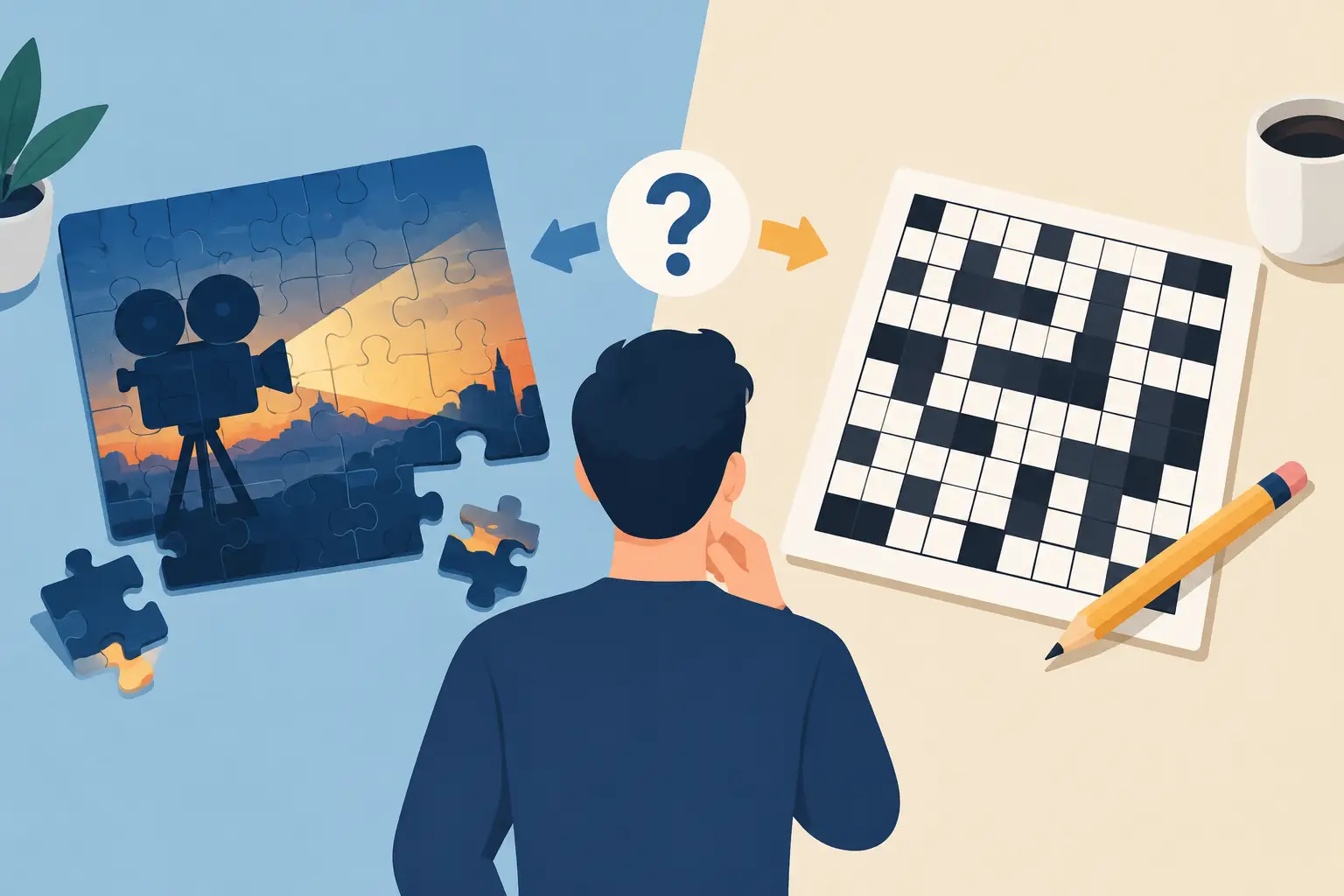
You have five spare minutes, a half-finished coffee, and the urge to prove that you know exactly who played the villain in that 1990s thriller. The film puzzle vs crossword choice comes down to what kind of win you want: a quick hit of movie recognition or the slow, satisfying click of a word grid coming together.
Both can become a daily ritual. Both make your brain work. But they ask different things of you, and one may fit your entertainment habits much better than the other.
Film Puzzle vs Crossword: The Core Difference
A crossword is built around language. You solve clues, fit answers into a grid, and use crossing letters to narrow down what belongs where. Even when the theme is movies, the main skill is wordplay: knowing synonyms, abbreviations, tricky clue conventions, and how constructors like to misdirect you.
A film puzzle is built around recognition and recall. The subject is the game. You might connect actors to films, identify a title from a clue, spot a shared credit, or work out the missing piece in a movie-related pattern. Your knowledge of cinema, casting, genres, quotes, releases, and pop culture does most of the lifting.
That distinction matters. A crossword can ask for a three-letter word you have not used since middle school. A film puzzle can ask you to remember the actor who showed up in both a superhero sequel and an indie drama you watched on a random Tuesday night. For movie fans, that is less like homework and more like getting credit for paying attention.
What Each Game Tests
Crosswords reward broad vocabulary and clue-reading instincts. A great solver learns that a clue can be literal, ironic, abbreviated, or built around a pun. The answer may be obvious only after you have a few letters in place. That process is the point.
Film puzzles reward a different kind of mental filing system. You are pulling up faces, titles, character names, decades, directors, and the strange little facts that stick after hundreds of movie nights. The answer can arrive in a flash: "Wait, that was definitely Frances McDormand." Or it can send you through a satisfying chain of associations from actor to role to film.
Neither format is automatically harder. It depends on your background. A lifelong crossword player may breeze through a cryptic clue but blank on the lead actor in a cult comedy. A serious movie watcher may identify a supporting cast member instantly, then stare at a traditional clue for "small amount" like it is written in code.
Pace Changes the Whole Experience
Crosswords can be a slow burn. That is ideal when you want to settle in, work a puzzle gradually, and return later with fresh eyes. A larger crossword may take 20 minutes, an hour, or longer. The grid invites patience.
A daily film puzzle usually fits a smaller window. It is designed for the moment between meetings, while waiting for takeout, or during the opening credits of your next watch. You do not need to commit to a long session to get a complete little challenge.
That faster pace does not mean less satisfaction. It just creates a different rhythm. A film puzzle often delivers a sharp moment of recognition followed by a quick decision. Crosswords build satisfaction layer by layer. Film games tend to make it feel more immediate.
If you want a game that can live beside your morning coffee without taking over the morning, film puzzles have an edge. If you like a puzzle that keeps you company on a flight or a quiet Sunday, a crossword may be the better companion.
Movie Knowledge Feels More Personal
The best part of a film-focused game is that it turns your taste into an advantage. Maybe you know every Best Picture winner, every Studio Ghibli voice cast, or every strange career detour Nicolas Cage has ever made. Maybe your superpower is remembering the one actor from a movie you saw once on cable in 2007.
A film puzzle gives that knowledge somewhere to go. It makes movie memory feel useful, even when the memory is wildly specific. You are not just filling letters. You are revisiting the films that shaped your taste, the stars you recognize on sight, and the arguments you have had with friends about whether a sequel was actually better.
Crosswords can certainly include film clues, but movies are usually one category among many. One moment you are naming an actor; the next, you need a river in Europe, a French phrase, or a baseball statistic. That variety is a feature for many solvers. For someone who wants a movie-first break, it can also dilute the fun.
The Social Side Is Different
A crossword is often private. You might solve it alone, compare completion times, or ask a friend for help with one stubborn clue. The finished grid feels like a personal accomplishment.
Film puzzles naturally invite conversation because movies already do. A single clue can become a text thread: "How did you not get that?" "I have never seen it." "Put it on the list tonight." Even a miss can be fun, because it points you toward a title, actor, or genre gap worth fixing.
That makes a daily film game easy to share without making it feel like a competition you have to train for. PlotLuck, for example, puts the focus on a quick daily movie challenge, which gives friends a common prompt without asking anyone to block off an hour.
There is a trade-off, though. Crosswords offer more room for collaborative solving when people are sitting together with time to spare. A film puzzle works best as a quick shared spark. One is a table activity; the other is a group-chat moment.
When a Crossword Is the Better Pick
Choose a crossword when you want language to be the challenge, not the subject matter. It is a strong choice for building vocabulary, enjoying clever construction, and working through a puzzle that reveals itself slowly.
It also wins when you like partial progress. You can finish half a grid, walk away, and let the unanswered clues simmer in the back of your mind. For some people, that unfinished tension is satisfying rather than annoying.
A crossword may also be more forgiving of uneven interests. You do not need to know movies, sports, history, music, and science equally well to make progress. Crossing answers can rescue you. The grid gives you a structure for educated guesses.
When a Film Puzzle Is the Better Pick
Choose a film puzzle when you want your screen-time habits to count for something. It is especially good if you already follow streaming releases, watch awards season, trade recommendations, or instinctively say, "Oh, that is the guy from..." whenever a familiar actor appears.
It is also the better fit when you want a clean finish. A short daily challenge gives you a beginning, a middle, and an answer before your attention gets pulled elsewhere. No giant grid waiting to be completed. No need to learn crossword shorthand before you can enjoy the game.
Film puzzles are not just for encyclopedic movie buffs, either. The fun comes from the mix of confidence and discovery. You might nail a question about a blockbuster, miss one about an older classic, and leave with a new film to watch. That is a pretty good return for a few minutes of play.
You Do Not Have to Pick One Forever
The real answer to film puzzle vs crossword is mood. Some days, you want the quiet concentration of a grid and a clue that fights back. Other days, you want to test whether all those late-night watches and "one more episode" decisions have made you better at movie trivia.
Try using them for different moments. Save crosswords for longer breaks when you want to settle in. Make a daily film puzzle your quick entertainment check-in, the same way you might scan what is new to stream or send a trailer to a friend.
Your best daily game is the one you actually want to come back to tomorrow. If movies are already part of how you relax, talk, and remember things, give that knowledge a few minutes to shine.