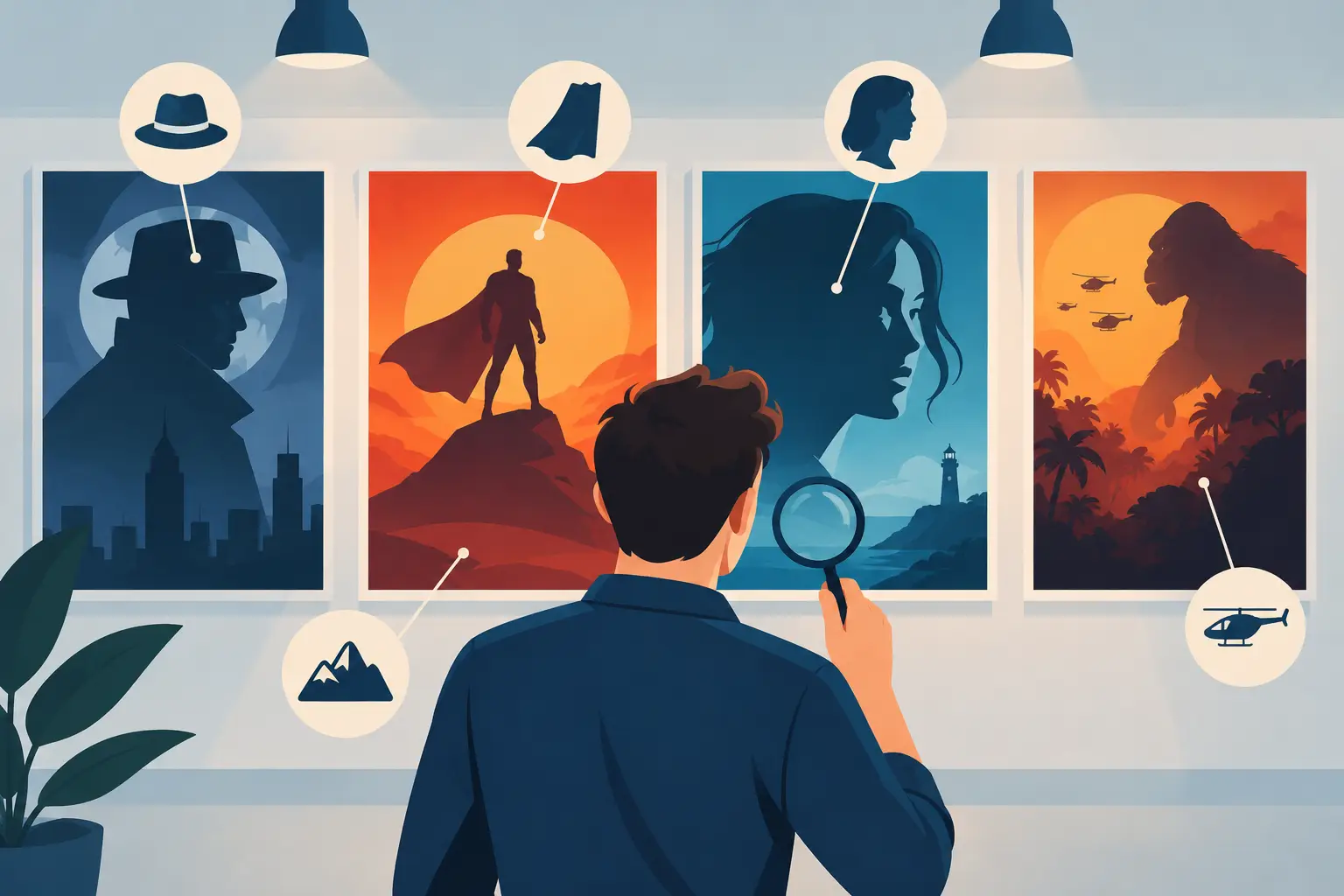
A poster puzzle can make a movie you have watched five times feel completely unfamiliar. Remove the title, crop out a face, blur one famous prop, and suddenly your brain is staring at a color palette instead of a film. This guide to cinema poster clues helps you turn that first blank stare into a smarter, faster guess.
The trick is not memorizing every poster ever made. It is learning what poster designers repeat: star placement, genre colors, signature objects, taglines, silhouettes, and the strange visual choices that only make sense for one movie. Start with what the image is telling you, not the first title that jumps into your head.
Read the Poster Before You Guess
Your first guess should come after a quick scan, not during it. Give yourself a few seconds to identify the biggest signal on the poster: a person, an object, a setting, or a graphic concept. A shark shape, a red balloon, a glowing suitcase, and a black-and-white city skyline each point toward very different corners of movie history.
Then ask what kind of poster you are seeing. Is it a theatrical one-sheet built around a famous actor? A minimalist re-release design? An illustrated classic? A streaming thumbnail-style image? This matters because the same movie can have wildly different promotional art across countries, decades, and home releases.
A face-heavy poster often wants you to recognize a performer. An object-heavy poster usually wants you to recall the premise. A poster with almost no recognizable subject may be selling mood, genre, or a famous title treatment. Do not treat every clue as equally valuable. The largest visual element is usually the loudest clue.
Start With Genre, Era, and Tone
Before naming a title, narrow the field. Genre is not glamorous, but it saves guesses. Bright primary colors, exaggerated expressions, and crowded compositions often suggest comedy or family adventure. Blue-gray shadows, isolated figures, and a single point of light lean thriller, sci-fi, or drama. Blood-red accents can mean horror, crime, romance, or all three, so use them as a starting point rather than proof.
The era can be just as useful. Painted ensemble posters may point to older blockbusters, fantasy films, or action movies from the 1980s and 1990s. Sparse typography and a clean central object can suggest prestige horror or indie drama from the 2010s onward. Grainy photography, a washed-out palette, and a huge floating head might be a period design choice rather than a clue about the movie itself.
Tone also helps eliminate bad answers. Ask whether the image feels goofy, threatening, glamorous, melancholic, absurd, or epic. A poster for a serious crime drama rarely uses the same visual language as a teen comedy, even when both feature suits, cars, and city streets.
The Best Cinema Poster Clues Are Specific
General clues create possibilities. Specific clues create answers. A cowboy hat is broad. A cowboy hat paired with a whip, leather jacket, and ancient temple imagery is not. A yellow car is broad. A yellow car with a black racing stripe, a robot-like grille, and explosions behind it is doing more work.
Look for combinations rather than isolated details. One clue may be decoration. Three connected clues are usually the poster's identity. A rainy neon street plus a lone figure in a trench coat plus a futuristic skyline is more useful than any one of those elements alone.
Pay special attention to these high-value details:
- Distinctive props, such as a mask, weapon, book, phone, doll, vehicle, or piece of clothing.
- Unusual settings, including a hotel hallway, a spaceship corridor, a courtroom, a suburban cul-de-sac, or a desert road.
- Character grouping, like a team lined up shoulder-to-shoulder, a couple back-to-back, or a tiny figure facing something enormous.
- Visual motifs, such as eyes, mirrors, flames, clocks, portals, flowers, or repeated symbols.
The best clue is often the detail that would look bizarre in any other movie. A generic gun is weak. A gun held beside a Bible, a rabbit, or a bright pink dreamhouse is probably not generic anymore.
Watch for the Poster’s Composition
Poster composition is a quiet giveaway. Many franchises repeat a visual formula across sequels: central hero, supporting cast arranged in layers, villain looming above, and a familiar logo at the bottom. If you recognize the formula but not the installment, focus on costumes, locations, and who has been promoted to the center.
Minimalist posters can work in reverse. When a design has only one object, that object is almost always the point. A red stapler, a cracked teacup, a cassette tape, or a pair of ruby slippers can carry an entire puzzle. If the image is sparse, resist the urge to invent a complicated theory. The obvious object may be the answer path.
Use Faces Carefully
Recognizing an actor can solve a puzzle instantly, but it can also send you into the wrong filmography. A cropped face, heavy makeup, a period costume, or a poster from 20 years ago can make even a familiar star look unfamiliar.
Instead of asking, “Who is that?” ask, “What does this person look like they are playing?” Their costume, expression, posture, and surroundings can narrow the role before you identify the performer. A stern person in a navy uniform suggests a different set of movies than a nervous person holding a bouquet outside a chapel.
If you do identify a star, pair that recognition with another clue before locking in the answer. Actors appear in too many movies, and ensemble posters often feature someone who is not the lead. The actor might be your route to a title, but the setting or prop is what confirms it.
Separate Original Art From Alternate Art
This is where poster puzzles get sneaky. You may know the famous theatrical poster, while the puzzle uses a limited reissue, an international design, or a character poster from the same campaign. The movie is still familiar. The art is not.
When the design feels off, look for the film's unchanging identity: its characters, world, premise objects, franchise iconography, or title-era styling. Alternate art often exaggerates one theme. A heist movie might become a poster full of cash and masks. A romance might become a poster focused only on hands. A monster movie might hide every human face and spotlight the creature.
This is also why exact color matching can be risky. Posters are recolored for digital releases, remasters, special screenings, and regional marketing. Use color to establish mood, then rely on subjects and symbols to make the call.
Build a Guessing Ladder Instead of Free-Associating
Random guessing feels fast until it burns every useful thought at once. A better method is to move from broad to narrow: genre, era, setting, character type, standout object, then title.
Say you see a lone child, a bicycle, moonlight, and a large glowing shape in the sky. First, you might call it family sci-fi. Then you place it in the 1980s visual tradition. Then you notice the bicycle and the glowing shape. Now the title is not a wild leap. It is the most likely match.
If a guess does not fit every major clue, keep it provisional. Good puzzle solving is less about instant certainty and more about dropping weak options quickly. You want the title that explains the whole image, not one detail you happen to recognize.
On a daily movie game such as PlotLuck, this habit makes each puzzle more satisfying. You are not just recalling trivia. You are reading the visual language movies use to sell themselves in one frame.
When You Are Stuck, Change the Question
Staring harder rarely helps. Shift your angle. Instead of asking what movie the poster is, ask what the poster wants you to feel. Is it promising danger, nostalgia, romance, spectacle, mystery, or chaos? Then ask which element is least likely to be accidental.
A tiny accessory can matter more than a giant face. A poster may hide its title but leave behind a recognizable hairstyle, a famous color combination, or a landmark. If the crop is tight, imagine what likely surrounds it. Is that blue light from a police siren, a portal, a nightclub, or a spaceship? Context turns fragments into a scene.
It also helps to know when not to overthink. Some posters are designed around a single famous image, and the puzzle is testing whether you have seen it before. Other times, the image is vague because the intended answer is a mainstream hit with recognizable cast or branding. Match the complexity of your reasoning to the complexity of the clue.
Keep Your Movie Memory Active
Poster knowledge grows through exposure, but you do not need homework. Notice the key art when you choose a movie, scroll a streaming app, see a theater lobby display, or send a trailer to a friend. Mentally name the poster's central promise. “This is selling the monster.” “This is selling the cast.” “This is selling one weird premise.”
Over time, you will spot repeated patterns across directors, studios, franchises, and genres. That is the real edge: not perfect recall, but quicker pattern recognition. The next time a cropped image tries to fool you, let the poster give up its clues one at a time.