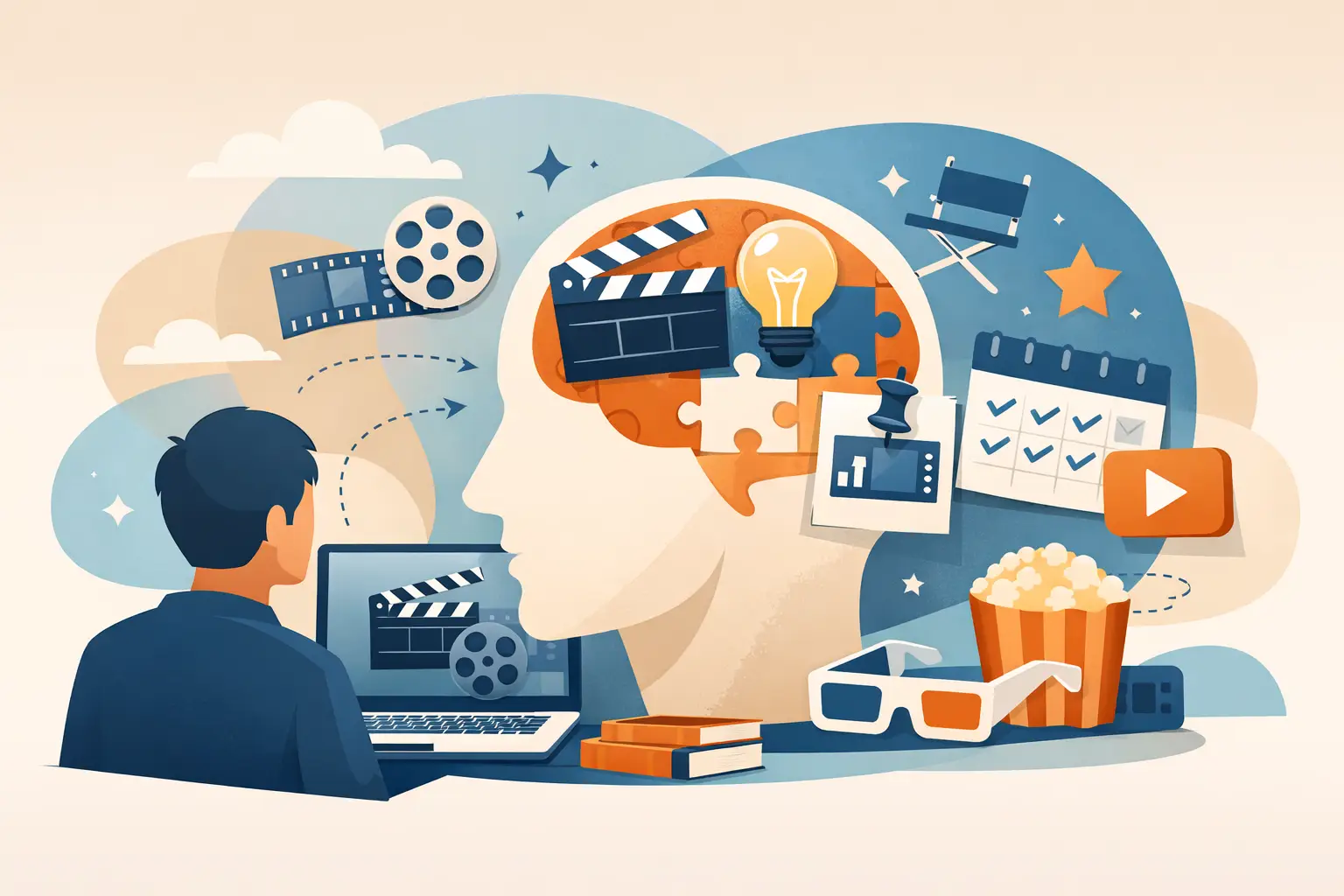
You can watch a great movie on Friday and blank on the director by Monday. Then someone mentions a supporting actor, a killer final scene, or the year it came out, and suddenly your brain offers nothing but vibes. Learning how to make movie knowledge stick is less about having a photographic memory and more about giving your movie brain a reason to retrieve what it knows.
Film knowledge is not one giant fact pile. It is a web of titles, faces, genres, decades, studios, character names, quotes, and connections. The more often you pull on those threads, the easier they are to find next time.
Stop treating every movie like a one-time watch
A movie can be a two-hour escape, and there is nothing wrong with that. Not every comedy needs a post-credit study session. But if you want details to last, give yourself one small moment of attention after the credits.
Pick the detail that made the movie feel like itself. Maybe it was the director's visual style, the performer who stole every scene, the source novel, the setting, or the way the soundtrack changed the mood. One memorable anchor is better than trying to memorize a full cast list while the next streaming suggestion starts autoplaying.
Say it in a sentence, even if you are alone: “That was the 1999 thriller with the twist ending and the actor from that other movie I love.” Your wording does not have to sound like a review. It just needs to connect the film to something already stored in your head.
Build connections, not flashcards for everything
Movie facts stick when they have somewhere to go. A title becomes easier to recall when it sits next to related titles: other films by the same director, movies set in the same city, performers who worked together again, or thrillers from the same era.
If you watch a Coen brothers movie, your brain has more to work with when you compare its humor or visual choices with another Coen film. If a familiar actor appears in a tiny early role, that is a useful hook too. You are not collecting trivia in a vacuum. You are building a mental map of cinema.
This also means you do not need to force obscure facts. Knowing the broad shape of a filmmaker's work is often more useful than memorizing every release date. Exact years, awards, and character names can come later, once they have context.
Use recall to make movie knowledge stick
Rewatching helps, but recalling is what does the heavy lifting. When you try to answer a question before checking the answer, your brain practices finding the information rather than simply recognizing it.
That is why a question such as “Which movie paired these two actors?” can teach more than scrolling through a list of credits. The brief struggle matters. It tells your brain that this information is worth keeping.
After a movie, test yourself with a few quick prompts. Who directed it? What decade was it released in? Which actor surprised you? What other movie does it resemble? You do not need a notebook, a rating system, or a ten-minute ritual. A few seconds of honest recall can do the job.
The goal is not to become the person who corrects everyone at movie night. It is to make your own viewing more rewarding. When references, casting choices, and genre patterns start clicking into place, movies get bigger than their runtime.
Let wrong answers do some work
Getting a film question wrong can feel annoying, especially when the answer is almost there. That near-miss is useful. It shows you the connection your brain tried to make and gives the correct answer a place to land.
Suppose you confuse two 1990s courtroom dramas, or remember the lead actor but not the title. Do not just replace the wrong answer and move on. Notice the difference: one was based on a John Grisham novel, the other had a different director, a different setting, or a different co-star. Contrast makes similar films easier to separate later.
A little friction is good. If every answer comes instantly, you are mostly reviewing what you already know. If every question is impossibly deep-cut, you stop having fun. The sweet spot is the one that makes you pause, guess, and want to know why the answer is right.
Turn film knowledge into a daily habit
A weekend marathon can create a lot of memories, but daily repetition keeps them active. Five minutes spent recalling a movie fact today is often more effective than cramming fifty facts once a month.
Give the habit a trigger that already exists. Try a quick film question with your morning coffee, on a lunch break, or while waiting for the train. The timing is less important than the repeat. Your brain begins to expect a small movie challenge, and that expectation makes the habit easier to keep.
Daily film puzzles are built for this kind of practice. A quick round at PlotLuck can bring old titles back to the surface, introduce a fresh connection, and give you a clean reason to return tomorrow. It is movie trivia without turning your free time into homework.
Keep the session short enough that you will actually do it. Stopping while you are still having fun is better than building a complicated routine you abandon after three days.
Watch with one question in mind
Before pressing play, choose one simple lens. You might watch for how a director uses music, how a lead actor changes from an earlier role, or what makes the movie fit its genre. This gives your attention a target without draining the fun out of the movie.
For a horror movie, notice what the film hides versus what it shows. For a romantic comedy, pay attention to the obstacle that keeps the central pair apart. For an action movie, track the location changes and the way the stakes escalate. Those observations make plot points easier to retrieve because they become part of a pattern.
It depends on the movie, of course. A dense mystery may reward close attention to names and clues. A big, breezy blockbuster may be better remembered through one standout set piece and the actor chemistry. Do not use the same system for every film. Use the detail the film makes easiest to care about.
Talk about what you watched
The fastest way to find out what you remember is to tell someone else about a movie. Recommend it to a friend. Argue lightly about the ending. Explain why a performance worked. Even a two-sentence text - “Watch this if you liked that other movie” - forces you to identify the comparison.
Social memory is sticky because it adds emotion and repetition. A quote becomes memorable because your group keeps using it. A director's name stays with you because someone introduced you to their work. You do not need a formal film club, though one can be great. One good conversation is enough.
Be careful not to turn every chat into a fact-checking contest. People remember movies differently, and personal reactions are part of the fun. The point is to trade connections, not win a quiz bowl.
Revisit movies at the right distance
Immediate rewatching is enjoyable, but spacing out your recall gives memory more staying power. Return to a movie question a day later, then a week later, then whenever the title pops up again. Each successful retrieval strengthens the path back to it.
You can do this casually. When an actor appears in something new, name another role before looking it up. When awards season rolls around, think of previous winners. When a friend picks a movie, ask yourself what else the director made. Real life supplies plenty of prompts.
The best movie knowledge is not a perfect internal database. It is the ability to recognize a face, follow a reference, make a sharp recommendation, and enjoy the next movie a little more because the last one left a trace.
Tonight, pick one detail worth carrying out of the credits. Tomorrow, see if you can call it back before your first cup of coffee.