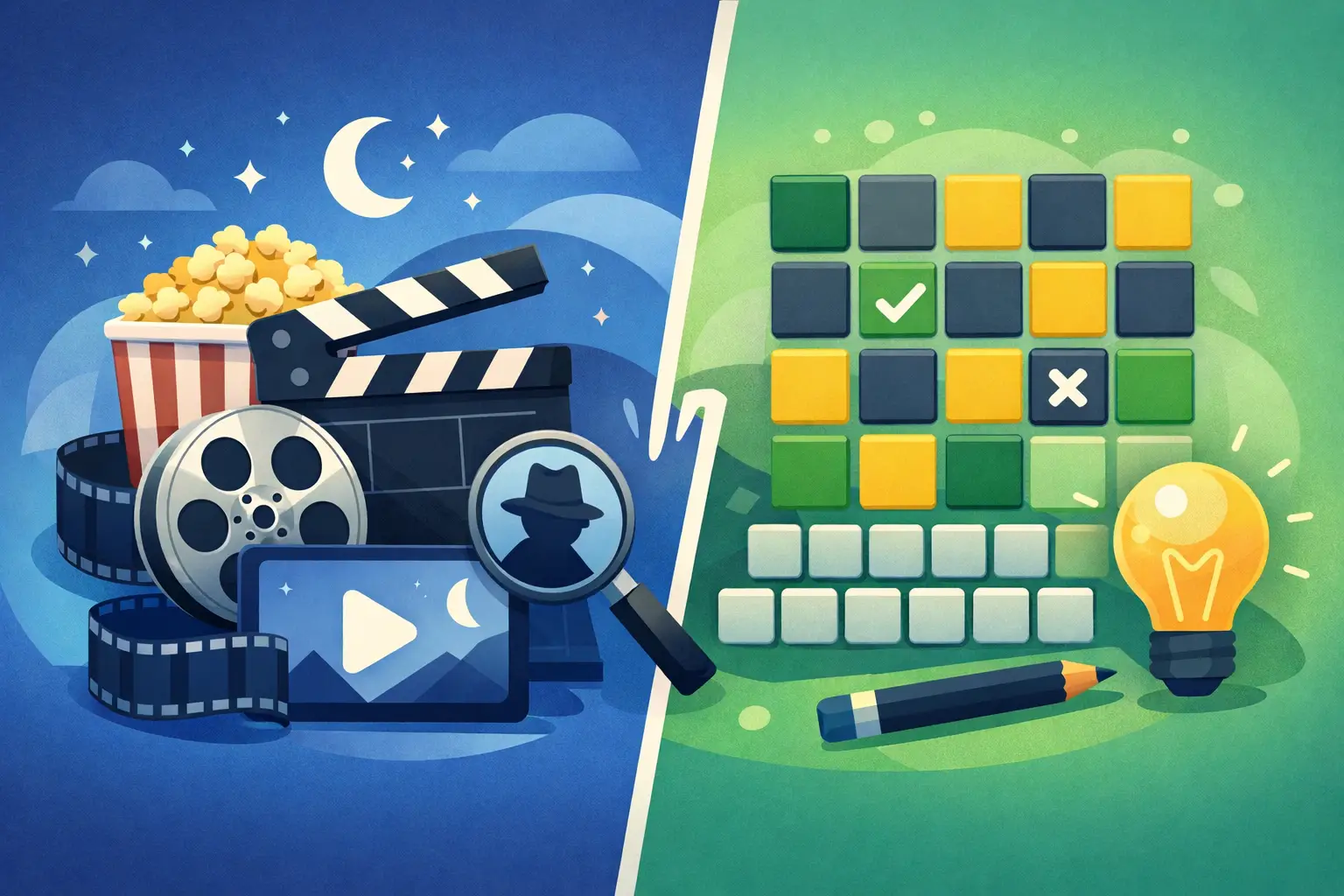
Some daily games fill two quiet minutes. Others turn into a ritual. That is the real split in movie challenge vs wordle - not which one is better in the abstract, but which one fits the way you like to think, guess, and show off a little.
Wordle became a daily habit because it is clean, fast, and instantly legible. You open it, type five letters, and you know the rules in seconds. A movie challenge works differently. The hook is not pure pattern recognition. It is memory, taste, genre awareness, cast recall, poster instinct, and the weirdly satisfying feeling of knowing a film from almost nothing.
If you are a movie person, that difference matters more than it sounds.
Movie challenge vs Wordle: the core difference
At a glance, both formats live in the same corner of the internet. They are daily, low-friction, and easy to share. They reward consistency. They also give you a small hit of satisfaction without asking for a big time commitment.
But the brainwork is different.
Wordle is a language puzzle. Even when you play strategically, your success depends on letter frequency, word structure, and narrowing possibilities. It feels mechanical in a good way. Every guess gives usable information, and the puzzle gradually reveals itself.
A movie challenge is closer to cultural recall. You are not just solving a system. You are connecting clues to something you have seen, heard about, quoted, argued over, or scrolled past on streaming menus for years. The answer is often tied to your relationship with movies, not just your logic.
That makes movie games feel more personal. It also makes them less universal. If you do not care much about film, the challenge can feel niche. If you do care, that niche is exactly the point.
Why Wordle became a habit so fast
Wordle works because almost nothing gets in your way. There is no fandom barrier. No genre knowledge. No need to know release dates, directors, or whether that actor was in the sequel or just the reboot.
You just start.
That simplicity gives Wordle a huge edge with broad audiences. It is easy to recommend to friends, parents, coworkers, and group chats full of people who have nothing else in common. It also feels fair. Even if you fail, you can usually tell why.
There is another advantage too. Wordle trains you. The more you play, the better your opening guesses and deduction habits become. Improvement feels measurable. You are building a repeatable skill, even if luck still shows up.
For a lot of players, that is the appeal. The game does not care what movies you watch, what music you like, or how online you are. It only cares whether you can find the word.
Why a movie challenge can be more fun
A movie challenge gives up some of Wordle's universality in exchange for personality.
That trade-off is worth it for the right audience. If you are already the person who recognizes an actor from one blurry frame, remembers a soundtrack cue instantly, or can name a 1999 thriller from a single plot detail, a movie puzzle feels more alive. It taps into taste and memory instead of only process.
That is a big reason movie-first games are so shareable among film fans. A good result does not just say, I solved it. It says, I know my stuff.
There is also more room for variety. A word puzzle usually stays within one core mechanic. A movie challenge can spin across posters, cast clues, taglines, stills, genres, release years, plot fragments, and visual hints. The daily structure stays familiar, but the route to the answer can feel fresher.
That freshness matters when people are deciding whether a game stays in their routine or starts feeling automatic.
Movie challenge vs Wordle on difficulty
Difficulty is where the comparison gets interesting, because harder does not always mean better.
Wordle's difficulty is mostly transparent. You can see your wrong letters, right letters, and partial hits. Even when the answer is obscure, the path is visible. That keeps frustration in check.
A movie challenge can swing more wildly. If the puzzle lines up with your taste, it feels easy. If it leans into a blind spot, it can feel brutal. Someone raised on horror and 2000s comedies may breeze through one day and completely blank on a prestige drama from the 1970s the next.
That variability can be a feature, not a flaw. It creates better conversation. It also gives the puzzle more texture over time. But it does mean movie games depend more on curation. If the picks are too mainstream, serious fans get bored. If they are too obscure, casual players bounce.
The best movie challenge understands that balance. It tests film knowledge without turning every day into a gatekeeping contest.
The social factor is different too
Both game types are social, but they create different kinds of sharing.
Wordle sharing is mostly performance plus mystery. You post the colored boxes, and other players understand the struggle without seeing the answer. It is elegant, standardized, and weirdly addictive.
A movie challenge usually creates more identity-driven sharing. People do not just compare how many tries it took. They compare what kind of movie brain they have. Did you get it from the cast? The image? The plot clue? Did you miss an obvious classic and now need to defend yourself in the group chat?
That kind of sharing feels messier, but often more fun. It invites opinions. It sparks mini debates. It reminds people that movies are social objects, not just answers.
For entertainment-focused players, that gives movie puzzles a stronger community vibe. They create conversation around the thing itself, not just the solving pattern.
Which one has better replay value?
If you define replay value as long-term habit strength, both formats can work. They just hold attention in different ways.
Wordle survives on consistency. The rules barely move, and that stability is the product. You know exactly what your daily two minutes will feel like.
A movie challenge survives on relevance and surprise. It keeps you coming back because there is always a new film angle, a new clue format, or a new chance to prove your taste has range. For movie fans, that can be more durable than another five-letter word.
It does depend on how central film is to your daily media life. If movies are background entertainment to you, the movie format may feel occasional rather than essential. If cinema is part of how you talk, scroll, and spend your free time, a daily film puzzle can fit more naturally than a generic word game.
That is where a focused experience like PlotLuck makes sense. It is not trying to out-Wordle Wordle. It is giving movie fans a daily puzzle that actually matches what they care about.
Who should pick which?
If you want pure simplicity, Wordle still wins. It is easier to explain, easier to recommend broadly, and easier to play regardless of mood or knowledge base.
If you want a game that feels more connected to your interests, a movie challenge has more personality. It can be smarter in a different way - less about optimizing guesses, more about recognizing patterns in pop culture and film memory.
There is no universal winner in movie challenge vs wordle because they satisfy different cravings. One is clean and abstract. The other is niche and expressive. One asks, can you solve this system? The other asks, how deep does your movie brain go?
That second question tends to stick with people who already live in trailers, streaming queues, cast lists, award chatter, and half-remembered scenes. It feels less like homework and more like being in on something.
The better daily game is the one that feels like you
The best daily puzzle is not the one with the biggest audience. It is the one you actually want to open tomorrow.
For some people, that will always be Wordle's tidy grid and predictable rhythm. For others, the better habit is a movie challenge that turns film knowledge into play and gives each day a little more character.
If your brain lights up faster at a plot clue than a vowel pattern, you probably already know your answer.