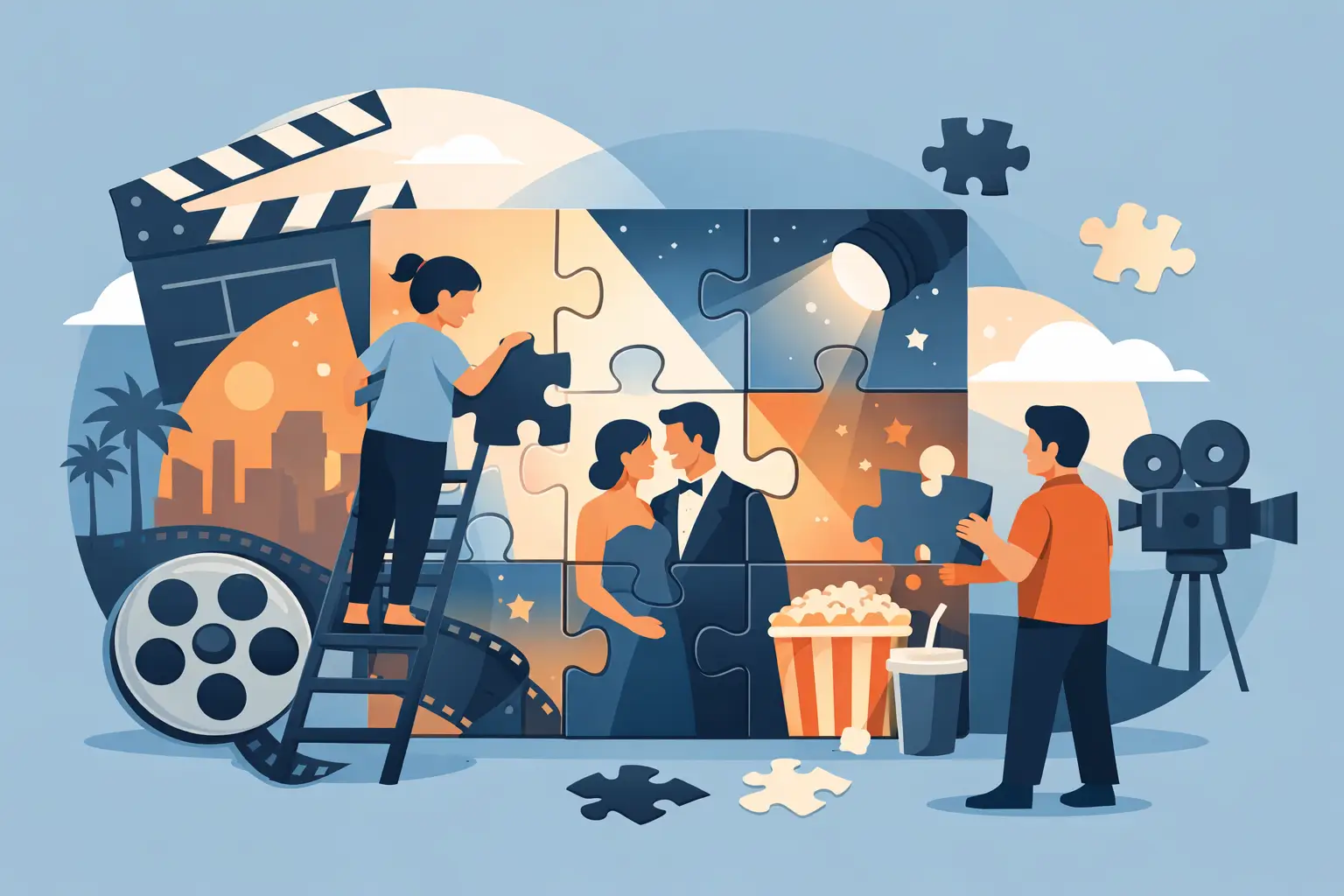
Some people unwind by scrolling. Others want a better five-minute habit - something quick, a little clever, and way more satisfying than staring at another feed. That is exactly where a movie puzzle for adults fits: it turns film knowledge into a daily challenge that feels fun, low-pressure, and just competitive enough.
The appeal is simple. Movies already live in your head. You remember opening scenes, famous lines, weird side characters, poster art, soundtrack cues, and that one actor who keeps showing up in everything. A good movie puzzle gives all that stored-up knowledge somewhere to go. Instead of passively consuming movie culture, you get to play with it.
What makes a movie puzzle for adults different
A lot of puzzles are built around pure logic or vocabulary. Those can be great, but they are also generic. A movie puzzle for adults has a built-in point of view. It rewards pattern recognition, memory, taste, and cultural fluency all at once.
That matters because adult players usually are not looking for busywork. They want a challenge that respects their time and gives a small payoff fast. Movie-themed puzzles do this well because the subject is already familiar. You do not need to learn a complicated system. You just need enough film knowledge to connect the dots.
The best versions also avoid becoming trivia exams. If a puzzle only works for people who know the cinematographer of a 1974 art-house release, the audience gets small very quickly. On the other hand, if every answer is a mega-blockbuster from the last two years, the challenge gets flat. The sweet spot sits in the middle: recognizable enough to feel fair, specific enough to feel rewarding.
Why adults keep coming back to daily movie puzzles
Daily formats work because they remove friction. You do not have to decide what to play, when to start, or how much time to invest. There is one challenge, it resets every day, and you either get it or you do not. That rhythm is part of the fun.
For adults, that structure matters even more. Most people are not looking for another app that asks for an hour of attention. They want a compact break between meetings, during lunch, or while waiting for coffee. A daily movie puzzle feels manageable. It gives you a tiny win without trying to take over your afternoon.
There is also the identity factor. Movie fans like proving they know their stuff, but usually in a way that feels playful, not performative. A puzzle gives that knowledge a shape. You are not arguing in a comment section about whether a sequel is underrated. You are solving something. That is cleaner, more satisfying, and often more social.
When people share results, they are not just saying they finished a game. They are signaling taste. They are saying, I got the reference, I spotted the clue, I know this world. That is a strong hook for anyone who follows film culture closely.
A good movie puzzle should feel smart, not exhausting
This is where many entertainment puzzles either click or fail. The challenge has to feel real, but the experience should still feel light.
If every round requires deep recall from a narrow genre, casual players bounce. If the clues are too obvious, movie buffs get bored. The best puzzle design balances confidence and doubt. You want the player to think, I know this, while still needing to work for the answer.
A few things usually separate a strong puzzle from a forgettable one. First, the clue format should be instantly readable. That might be frames, plot hints, cast connections, taglines, or genre signals. Second, the answer should feel fair in hindsight. Even if you miss it, you should be able to see why it was the answer. Third, the play session should stay tight. Drag it out too long and the novelty wears off.
This is especially true for adults, because the puzzle is competing with everything else in the day. If it feels clunky, people leave. If it feels sharp and repeatable, it becomes a habit.
The formats that work best
Not every movie puzzle lands the same way. Some are better for broad audiences, while others attract a more hardcore crowd.
Visual puzzles tend to have the fastest appeal. A cropped still, a blurred poster, or a color palette from a famous scene can trigger recognition almost instantly. These are satisfying because they reward memory in a way that feels immediate.
Text-based puzzles can be stronger when they use plot logic instead of obscure facts. A clue like "small-town sheriff, summer panic, giant threat in the water" is more fun than asking for a release date. It lets players reason their way toward the answer, even if they are not 100 percent sure at first.
Connection-style games also work well for film fans. Link four movies by actor, director, franchise, setting, or award history, and you have a puzzle that feels more dynamic than standard trivia. These formats give players multiple entry points, which helps both casual solvers and people with deeper knowledge.
The trade-off is that niche formats can alienate players if the rules are not obvious right away. A movie puzzle should not need a tutorial every time. Fast understanding is part of the product.
Why movie knowledge makes puzzle-solving more fun
Movie fandom is unusually good fuel for games because it mixes memory with emotion. You do not just remember a title. You remember where you saw it, who recommended it, what scene stayed with you, or why you still quote it.
That emotional layer makes solving feel better. Getting the answer right is not only about being correct. It is about recognition. You spot the pattern and feel a little jolt of connection. That is stronger than many generic puzzle experiences because the subject already means something to you.
It also makes the challenge more flexible. A player might be great at horror, weak on musicals, and weirdly elite at identifying 1990s thrillers from one clue. That uneven knowledge is part of the fun. It keeps the puzzle from feeling purely academic.
For brands in this space, that is a huge advantage. You are not forcing users into a neutral game shell. You are meeting them inside an interest they already care about.
How to tell if a movie puzzle is worth your time
A solid movie puzzle for adults does three things right away: it starts fast, it feels fair, and it gives you a reason to come back tomorrow.
Start with speed. If you cannot understand the objective in a few seconds, the design is doing too much. The best daily games respect the fact that attention is limited.
Then look at the clue quality. Good clues narrow the field without spoiling the answer. Bad clues are either random or so broad they could describe twenty movies. Precision matters.
Finally, check whether the challenge resets in a way that feels fresh. Repetition is good for habits, but sameness is not. A daily puzzle should keep its core structure while varying the experience enough that each round feels new.
That is why focused platforms stand out. A movie-first experience is often more satisfying than a general trivia app trying to do everything at once. When the whole concept is built around film, the game usually feels cleaner and more intentional. PlotLuck is a good example of that approach: simple daily movie play, no extra noise, just a recurring challenge for people who actually like movies.
The best movie puzzle for adults fits real life
This is the part people underestimate. A puzzle can be clever and still fail if it does not fit how adults actually spend their time.
Most players want something they can finish before the next tab steals their attention. They want enough challenge to feel engaged, but not so much friction that it becomes homework. They want a game they can send to a friend without needing to explain the entire concept first.
That is why short, repeatable, themed puzzle formats keep growing. They match how people already live online. Quick session, clear goal, instant payoff, maybe a shareable result. Add movies to that formula and the fit gets even better because the subject has built-in fandom, recognition, and conversation.
A really good movie puzzle does not need to be loud. It just needs to be sharp. Give someone one fair challenge a day, make it satisfying to solve, and let their film brain do the rest.
If your idea of fun is recognizing a movie from almost nothing, that is not random useless knowledge - it is exactly the kind of knowledge that makes a daily puzzle worth opening tomorrow.