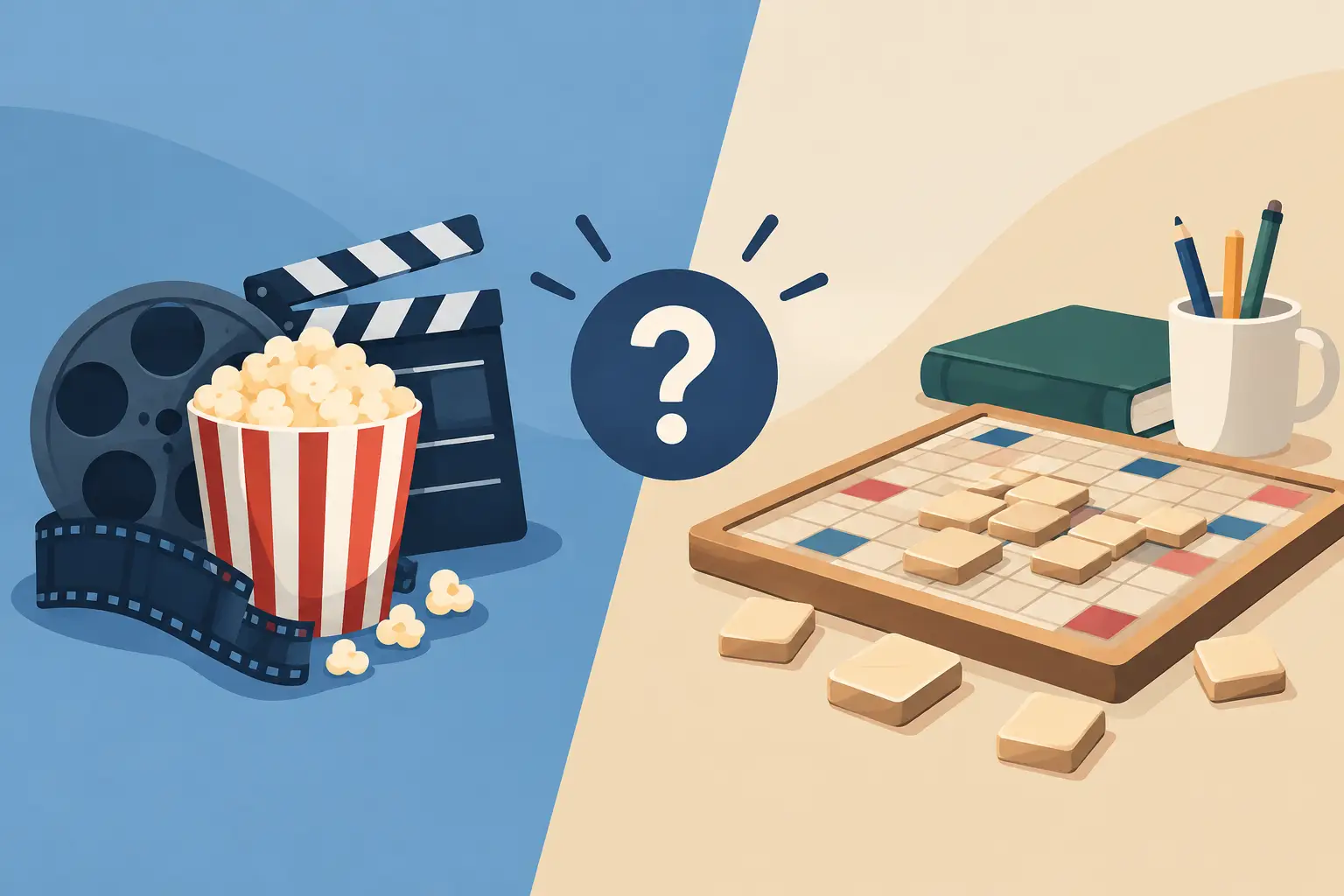
You know the feeling: you solve a five-letter word before coffee, then spend the next 20 minutes arguing about whether that actor was really the best part of the movie. That is where movie trivia vs word games gets interesting. Both offer a quick daily brain break. But they scratch different itches, and one may fit your routine a lot better than the other.
Movie Trivia vs Word Games: The Real Difference
Word games are built around language mechanics. You spot patterns, test combinations, eliminate letters, and make educated guesses. The pleasure is clean and contained: there is a right answer, a few clues, and a satisfying click when the board turns green.
Movie trivia runs on recognition. A title, a cast member, a quote, a director, a plot twist, a release year, or one strange bit of movie knowledge can send your brain flipping through a personal archive of theater trips, streaming nights, and group-chat debates. It is less about vocabulary and more about cultural memory.
Neither is automatically better. If you love a puzzle that works even when you are half-awake and have no interest in pop culture, word games are hard to beat. If movies are already part of how you relax, talk, and keep up with the world, a film puzzle makes that same short break feel more personal.
Word Games Win on Familiarity
There is a reason daily word puzzles became a ritual. The rules are usually obvious within seconds. You do not need to know a genre, remember a celebrity, or have watched anything recently. You only need a little language instinct and a willingness to try.
That low barrier matters. A strong word game can be played by your coworker, your uncle, and your friend who has never voluntarily watched an awards-season drama. Everyone begins with the same basic tool kit: the English language.
Word games also create a particular kind of calm. There is little context to manage. You are not wondering whether you missed a movie in 2014 or whether a clue is pulling from horror, animation, or classic Hollywood. You are simply working the puzzle in front of you.
For some players, that neutrality is the point. A word game can feel like brushing your teeth for your brain: small, reliable, and easy to repeat.
Movie Trivia Makes Knowledge Feel Social
The limitation of a general word game is also its strength: it does not say much about you. Solving it can feel great, but it rarely leads to a heated opinion, a recommendation, or a "wait, you have not seen that?" moment.
Movies do. Film knowledge is full of stories people want to tell. A question about a famous ending can lead to a debate about spoilers. A clue about a supporting actor can remind someone of an old favorite. Even a wrong answer can be fun when it exposes the weird connections your brain made between two movies.
That makes movie trivia naturally shareable. You are not only comparing scores. You are comparing taste, recall, and the particular corners of cinema you carry around with you. The person who gets every superhero clue may miss the black-and-white classics. The horror fan may dominate October and struggle with rom-coms. That variety gives a daily puzzle more personality.
For film fans, the challenge can also feel like a tiny reward for paying attention. All those credits watched, trailers discussed, and "one more movie" nights do not disappear when the screen goes dark. They become part of the game.
The best clues trigger recognition, not homework
Movie trivia can go wrong when it becomes a test of obscure facts with no payoff. Knowing the name of a third assistant editor from a 1987 thriller is impressive, but it is not always fun. The sweet spot is a clue that makes players think, "I know this," then enjoy the chase.
Good film puzzles balance accessible touchstones with deeper cuts. They leave room for a casual viewer to make progress and give dedicated fans a chance to flex. That balance matters more than making every question brutally difficult.
What Each Game Actually Tests
A word game tests pattern recognition, spelling, vocabulary, and strategy. Even when luck is involved, your choices shape the next clue. You can improve through better opening guesses, stronger elimination habits, and a sharper sense of common letter combinations.
Movie trivia tests recall, association, and attention. You may remember a movie because of a costume, a line reading, a poster, a soundtrack, or the fact that you watched it with friends on a rainy weekend. The answer is often stored beside a feeling, not a definition.
That difference changes the emotional payoff. In word games, the win is often, "I figured it out." In film trivia, it is more likely, "I knew that," or "How did I forget that?" One rewards deduction. The other rewards fandom.
Of course, the categories overlap. A clever movie puzzle can involve wordplay, and a word game can become part of someone’s identity. The more useful question is not which format is smarter. It is which kind of smart you want from a five-minute break.
Why Theme Can Build a Better Daily Habit
Daily games survive on return visits. A puzzle does not need to take an hour to earn a place in your day. It needs to be easy to start, satisfying to finish, and distinct enough that you want tomorrow’s version.
Generic word games have a huge advantage here because they are familiar. You know the deal before you open the page. But a focused theme creates a different kind of pull. If you are already checking what is new to stream, swapping movie opinions, or keeping a running mental list of films to watch, a movie puzzle fits a habit you already have.
Themed games also make variety easier to feel. One day might reward your memory of iconic villains. The next might send you hunting for a director’s filmography or connecting actors across a genre. The format can stay quick while the subject changes enough to avoid feeling repetitive.
That is the appeal of a daily film puzzle such as PlotLuck: it keeps the friction low while giving movie fans a reason to come back for a challenge that feels made for them.
The Trade-Off: Breadth Versus Belonging
Word games are broad. They welcome almost anyone, which makes them easy to share with a wide circle. The trade-off is that they can feel interchangeable. Once you have played a few similar formats, the experience may blur together unless the mechanics are especially sharp.
Movie trivia is narrower by design. Someone who does not care about movies may not see the appeal, and that is fine. For the people who do care, the theme creates belonging. It says this small slice of your day is for the thing you already love.
That focus also lets a game respect different levels of fandom. You do not have to be the person who knows every Oscar winner to enjoy a movie challenge. Maybe you know animated movies by heart. Maybe you can name every actor in a 1990s thriller. Maybe you have watched the same three comedies 30 times. Film knowledge is not one ladder. It is a collection of favorites.
Choose the Puzzle You Will Actually Return To
Pick word games when you want a universal, low-context mental reset. They are great for quiet mornings, travel days, and those moments when you want a challenge with no opinions attached.
Pick movie trivia when you want your puzzle to have a point of view. It is the better fit when you enjoy recognizing references, testing your pop-culture memory, and sending a result to the friend who insists they know more about movies than you do.
You do not have to pick a side forever. Keep the word puzzle for your language brain and the movie puzzle for your film brain. But if one of them makes you think about a favorite scene long after you finish, that is probably the daily game worth keeping.