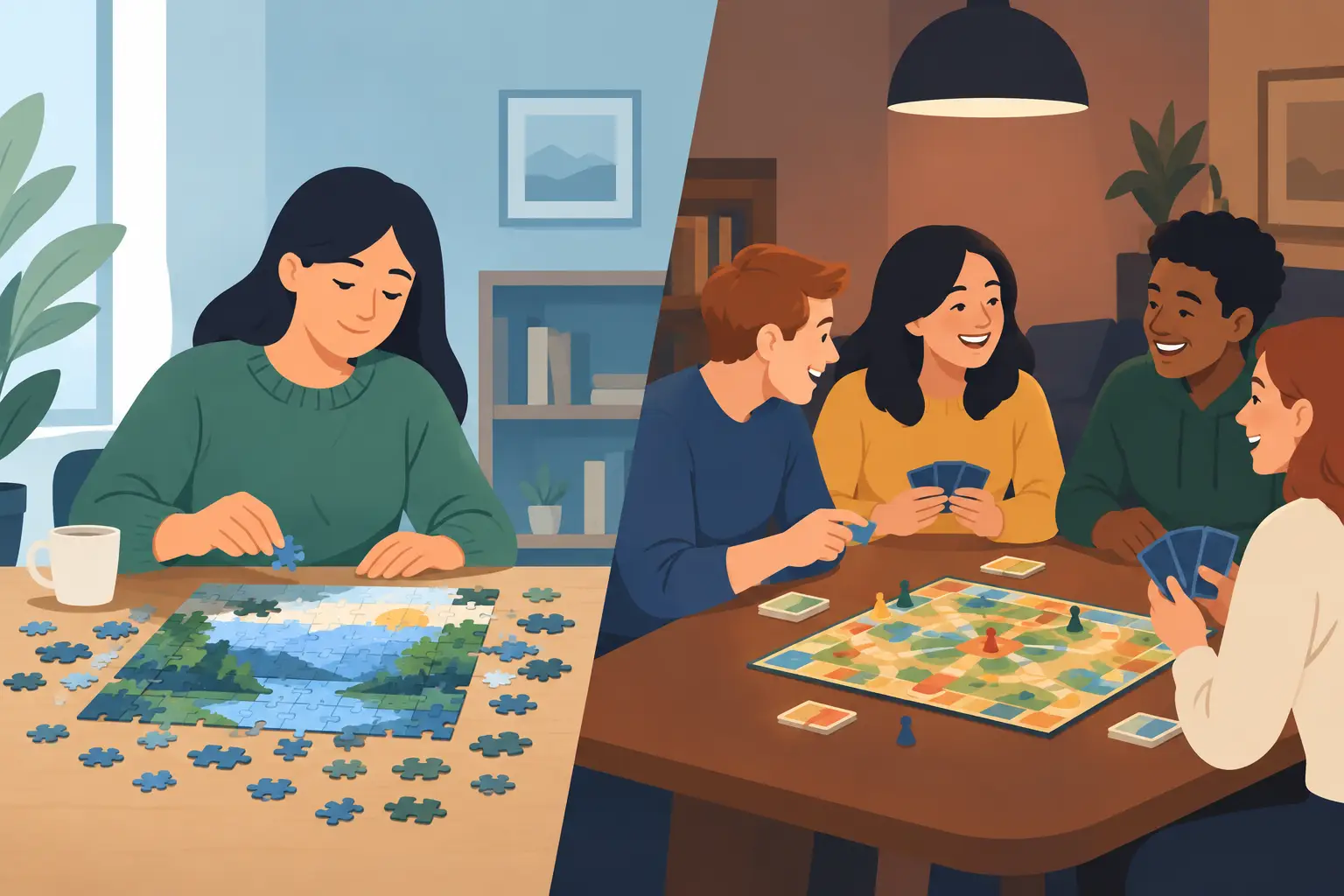
Your group chat finally agrees on a night to hang out. Then someone spends 20 minutes explaining rules, one friend checks their phone, and another says they would rather just watch a movie. A solo puzzle never has that problem.
That does not mean solo puzzles versus game nights is a contest with one obvious winner. They scratch different entertainment itches. One gives you a quiet, fast hit of satisfaction on your own schedule. The other turns knowledge, luck, and terrible guesses into a shared memory. Knowing which one you need can make your downtime feel a lot more fun.
What solo puzzles do better
Solo puzzles are built for the gaps in a day. You can play one while your coffee cools, between meetings, on the train, or while deciding what to stream. There is no planning, no waiting for people to show up, and no need to pretend you understand a rulebook after someone has explained it twice.
That low friction matters. A short puzzle gives your brain one clear job: spot the pattern, make the connection, remember the actor, name the film, get the answer. It is a small challenge with a clean finish line. Even when you miss, you usually learn a fact worth filing away for later.
For movie fans, the best solo games also make film knowledge feel active. Instead of passively scrolling past another trailer or ranking, you are pulling titles, characters, directors, and plot details from memory. A daily film puzzle such as PlotLuck turns that impulse into a repeatable ritual without asking for an entire evening.
The appeal of private wins
There is a special kind of satisfaction in solving something before anyone else gets a chance to weigh in. No loud friend blurting out the answer. No debate over whether a clue was unfair. Just you, the puzzle, and the moment the answer clicks.
Solo play can also be kinder to different energy levels. After a crowded day, even a fun game night can feel like another appointment. A puzzle is social only if you want it to be. You can send your result to a friend, compare guesses later, or keep the win entirely to yourself.
The trade-off is that solo games can become a little too quiet. A streak is satisfying, but it does not automatically create a story you will retell next month. If what you want is laughter, banter, or an excuse to see people, a daily puzzle cannot fully replace the room.
What game nights do better
Game nights turn entertainment into an event. The actual game matters, but so does everything around it: snacks on the table, the friend who insists on a rematch, the wildly confident wrong answer, and the running joke that appears after one ridiculous round.
For film people, group play brings out a different kind of expertise. One person knows every Best Picture winner. Another can identify a movie from a single costume detail. Someone else has watched every creature feature ever made. Those specialties collide in ways a solo game cannot create.
A good game night also gives people permission to be a little competitive without making it too serious. You can cheer for a lucky guess, challenge a questionable answer, or form temporary alliances against the person who somehow knows every quote from 1990s comedies. The point is not perfect knowledge. It is having a reason to react together.
The hidden cost of getting everyone together
Of course, group fun has logistics attached. Scheduling adults can feel harder than solving a mystery thriller. Different attention spans, different game tastes, travel time, food, and the question of when the night actually ends all shape the experience.
Game nights can also expose a mismatch in the room. A deep-cut cinema trivia game is great when everyone loves movies. It is less great when half the group came to catch up and the other half treats every answer like a final exam. The host has to read the vibe.
That does not make game nights fragile. It just means the best ones choose the right level of commitment. A 10-minute movie trivia round before a film works for a casual crowd. A longer strategy game may fit a group that plans around it. The format should serve the people, not trap them.
Solo puzzles versus game nights: choose by mood
The useful question is not which format is better. Ask what you want from the next 15 minutes or the next Friday night.
Choose a solo puzzle when you want a quick mental reset, a personal challenge, or a small screen break that still feels entertaining. It works especially well when your schedule is unpredictable or your social battery is low. You are not canceling plans or waiting for a quorum. You are simply playing.
Choose a game night when you want connection to be part of the entertainment. It is the better option when you have time, a willing group, and a game that matches the room. Shared reactions are the feature. A difficult clue can become fun because everyone is trying to solve it together, not because the answer itself is life-changing.
There is also a middle ground. Solve a daily puzzle alone, then drop your score or your most painful missed clue into a group chat. Settle a movie argument with a quick trivia question while dinner is being made. Use a short game as the warm-up before the main event. The boundary between solo and social play is more flexible than it looks.
Why movie puzzles work in both settings
Movies give people a built-in language. You may not share the same favorite genres, but most people have an actor they recognize, a quote they can finish, or a film they will defend forever. That makes movie puzzles unusually easy to share.
On your own, a movie clue can send you back through years of watching. You remember the first time you saw a scene, the friend who recommended it, or the plot twist that got you. With other people, those memories become conversation. One title turns into five recommendations and a debate about whether the sequel was actually better.
The best movie games leave room for both casual viewers and serious buffs. A player should be able to land a satisfying answer from mainstream movie knowledge, while devoted fans get the occasional clue that makes them feel seen. If every question is obvious, there is no spark. If every question is obscure, people check out. The sweet spot rewards curiosity as much as recall.
Build a better entertainment routine
You do not need to pick a side and defend it. Think of solo play as your daily movie snack and game nights as the occasional feature presentation. One keeps film knowledge active in small moments. The other gives that knowledge a social life.
If you are trying to play more often, start small. Make a short puzzle part of a moment you already have, like your morning coffee or post-lunch reset. If you want more group time, stop waiting for a perfect elaborate plan. Invite a few people over, pick one easy movie game, and keep the stakes low.
Your ideal balance may change week to week. Some nights call for headphones, a couch, and one puzzle you can finish before the credits of your day roll. Other nights call for friends arguing over a clue that everyone was sure they knew. Make room for both, and let the movie conversation continue after the game is over.