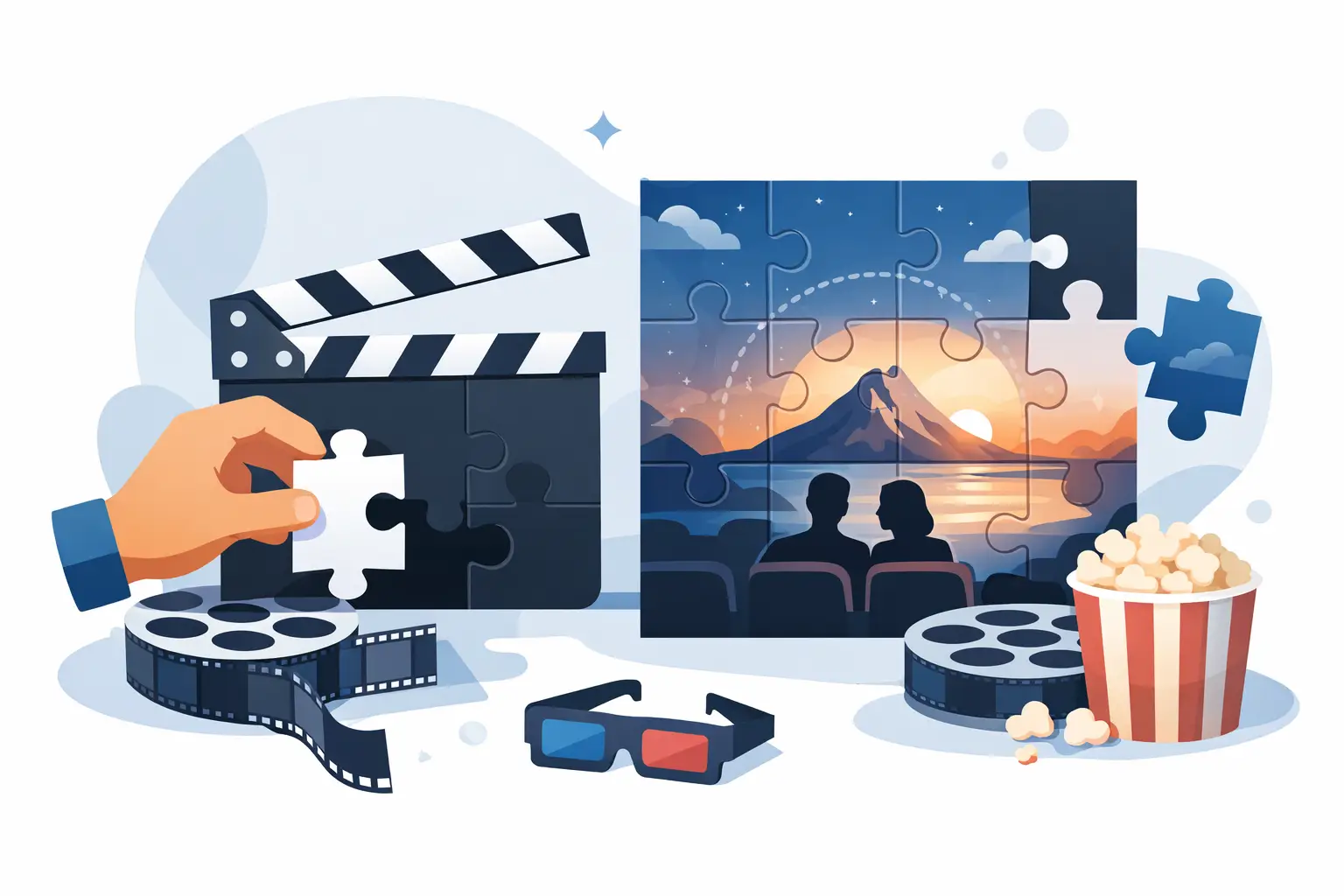
You know the feeling: a cast list, a blurry still, a quote with one key word missing - and suddenly your brain is rifling through years of movie knowledge at high speed. That is the basic appeal behind the question what is a movie puzzle. It is not just trivia, and it is not just a game. It is a short, focused challenge built around recognizing, recalling, and connecting movie-related clues.
A movie puzzle takes film knowledge and turns it into play. Sometimes you identify a title from hints. Sometimes you sort scenes, decode references, match actors to roles, or figure out a film from plot fragments. The format can change, but the core idea stays the same: you use what you know about movies to solve something.
That sounds simple because it is. The best movie puzzles are quick to start, satisfying to finish, and just hard enough to make a right answer feel earned.
What is a movie puzzle in practice?
If regular movie trivia asks, "Do you know this fact?" a movie puzzle asks, "Can you figure this out?" That difference matters.
Trivia is usually direct. Who directed this movie? Which year did it come out? Which actor played the lead? A movie puzzle is more interactive. It gives you partial information and asks you to work toward the answer. You are not only retrieving knowledge. You are interpreting clues, spotting patterns, and making smart guesses.
That is why movie puzzles feel more game-like than standard quizzes. They create a small moment of tension. You might recognize a detail without fully placing it. You might know the movie after clue two, or need clue five. Either way, the puzzle gives your brain something to do beyond reciting facts.
In practical terms, a movie puzzle can take a lot of forms. It might be visual, using posters, frames, props, or silhouettes. It might be text-based, using plot clues, dialogue, genre signals, or cast connections. It might even be logic-driven, where each guess narrows the field. The format is flexible, which is part of why the category works so well online.
Why movie puzzles feel different from movie trivia
The difference is less about content and more about experience. Movie trivia rewards recall. Movie puzzles reward recognition, deduction, and movie literacy all at once.
That makes them more inviting for a wider range of players. You do not need to be the person who memorized every Oscar winner since 1972. You just need enough familiarity with movies to start making connections. A casual viewer can solve one through instinct and recent watching habits. A serious film fan can solve it faster, or with fewer clues. Both get the same little hit of satisfaction.
There is also more room for momentum. Trivia can feel static if you either know the answer or do not. A puzzle gives you movement. Each clue changes the situation. Each guess teaches you something. Even when you miss, you are still playing.
That is a big reason movie puzzles work so well as a daily habit. They ask for a few focused minutes, not a long session. You show up, solve the thing, compare notes with friends, and move on with your day feeling slightly sharper and slightly more smug.
The main types of movie puzzles
Most movie puzzles fall into a few broad styles, even if they borrow from each other.
The most obvious is the title-guessing puzzle. You get clues about plot, cast, genre, release era, or setting, and try to name the movie. This is often the cleanest format because the goal is instantly clear.
Then there are image-based puzzles. These might use a cropped still, an abstracted poster, a color palette, or a visual detail like a costume or prop. These work well because movies are visual by nature. A single frame can trigger memory faster than a paragraph of clues.
Quote and dialogue puzzles lean on recognition. A line from a movie can be easy or impossible depending on how iconic it is, how many words are removed, and whether the clue includes context. The same goes for soundtrack-based or audio-based versions, though those depend more on platform and format.
Connection puzzles are a little more layered. Maybe several films share an actor, director, theme, or franchise link, and your job is to identify the missing piece. These tend to reward broader movie knowledge rather than memory of one specific title.
There are also logic-forward movie puzzles, where wrong guesses narrow future options. Those sit closer to word-game culture and are especially good for repeat play because they create strategy, not just recall.
What makes a good movie puzzle?
A good movie puzzle is easy to understand and hard to spoil. The rules should click almost instantly. If players spend more time decoding the format than solving the challenge, something is off.
The clue design matters even more. Good clues feel fair. They should point toward the answer without making it obvious too early. That balance is tricky. If a puzzle is too vague, it feels random. If it is too blunt, it is over before it starts.
The sweet spot is when a clue triggers recognition in stages. First you think, "I know this." Then, "Wait, I really know this." Then the title lands. That moment is the whole point.
A good movie puzzle also respects the audience. Not every puzzle should be built for hardcore cinephiles, and not every puzzle should rely only on giant blockbusters. The strongest format usually mixes accessibility with range. One day might reward mainstream movie memory. Another might favor genre fans or people with a strong feel for actors and directors. Variety keeps the game alive.
Speed matters too. For most players, the ideal puzzle does not feel like homework. It should fit into a coffee break, lunch scroll, or late-night phone check. Short does not mean shallow. It just means the friction is low.
Why the format works so well online
Movie puzzles fit the internet unusually well because they combine three things people already like: short games, pop culture fluency, and shareable results.
The short-game part is obvious. People like formats they can finish. A movie puzzle gives closure fast. That matters more than ever when attention is split across apps, streams, messages, and tabs.
The pop culture angle gives the puzzle personality. Solving a generic challenge is nice. Solving one built around movies says something about your taste. It feels closer to identity. If you are the person in your group chat who always catches references, remembers release dates, or insists the director's cut is better, a movie puzzle lets you prove it in a low-stakes way.
Then there is the social side. Daily puzzle culture works because people like comparing outcomes. Not in a huge competitive way, necessarily. More like, "How fast did you get it?" or "You missed that from one screenshot?" Movies are already conversational, so the puzzle becomes another reason to talk about them.
That is where a focused daily format has a real edge. A broad trivia site can offer endless content, but a single daily movie challenge feels cleaner and more repeatable. You know what you are showing up for.
Who are movie puzzles actually for?
Not just film-school people, and not just trivia diehards.
The best answer to what is a movie puzzle includes the audience too. It is for anyone who likes that quick mental click of recognizing something before the answer is fully visible. If you watch a lot of movies, quote them with friends, scroll streaming menus for too long, or have strong opinions about sequels, you are already the right kind of player.
That said, difficulty changes the audience. Some movie puzzles are built for broad appeal and stick to well-known titles. Others go niche and expect you to know cult horror, international cinema, or deep-cut performances from character actors. Neither approach is automatically better. It depends on the goal.
For a daily ritual, broader accessibility usually wins. People come back when they feel challenged but not shut out. A puzzle can still be clever without requiring encyclopedic knowledge.
That is part of the appeal behind movie-first formats like PlotLuck. The category works best when it knows exactly what it is offering: a quick, replayable film challenge that respects your time and your taste.
Why movie puzzles keep growing
Movie culture has changed. People still love films, but the way they engage is more fragmented now. One person is catching classics, another is deep in horror, someone else is living on streaming originals, and everybody is seeing clips out of context on social feeds.
A movie puzzle turns that scattered media knowledge into one simple interaction. It gives all that passive watching a small payoff. Suddenly remembering an actor's face, a one-scene location, or a weird plot detail becomes useful.
That is also why the format has staying power. It is not asking people to learn a new hobby. It is taking something they already consume and making it interactive. Low effort to start, satisfying to solve, easy to repeat.
And because movies cover every genre, era, and mood, the puzzle category has room to keep evolving. One format can lean visual. Another can go logic-heavy. Another can feel like pure fan service. There is plenty of space inside the same basic idea.
A movie puzzle is, at heart, a fast film challenge with a little mystery built in. It turns recognition into gameplay and movie knowledge into a daily win. If a puzzle can make you say, "Wait, I know this one," before your coffee gets cold, it is doing its job.